
Smarter Stacking Starts Here:
A Guide to Modern Palletiser Types

Conventional (Layer-Forming) Palletiser
What it does / Function
A conventional palletiser automatically arranges products into complete layers before placing each layer onto a pallet using mechanical systems such as sweep arms, pushers, and elevators. It is engineered for continuous, high-speed operation and delivers extremely consistent, stable pallet loads. These systems are typically integrated into fully automated packaging lines where throughput and reliability are critical.
Best for
High-volume production with uniform case or bag sizes and long, uninterrupted production runs.
Common industries
Food & beverage, consumer packaged goods (CPG), paper & tissue, pet food
Key advantages
-
Very high palletising speeds
-
Excellent load stability and repeatability
-
Proven, durable mechanical design
-
Ideal for 24/7 production environments
Robotic Palletiser
What it does / Function
A robotic palletiser uses an articulated industrial robot arm equipped with a gripper or vacuum tool to pick products and place them onto pallets according to programmed patterns. It offers software-controlled flexibility, allowing fast changeovers between products, pallet sizes, and stacking configurations.
Best for
Operations with multiple SKUs, frequent product changes, or custom pallet patterns.
Common industries
Food, beverage, pharmaceutical, personal care, e-commerce, contract packing
Key advantages
-
Highly flexible and reprogrammable
-
Compact footprint compared to large mechanical systems
-
Handles varied product sizes and packaging types
-
Future-proof for changing production needs

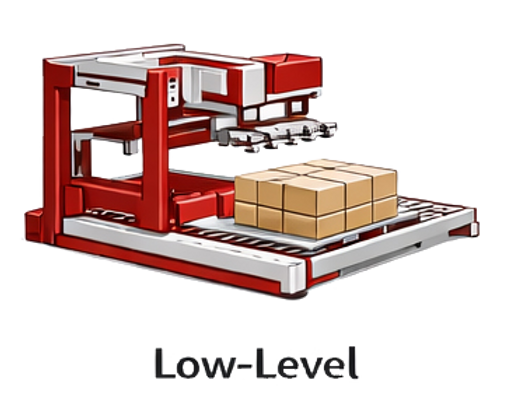
Low-Level Palletiser
What it does / Function
A low-level palletiser builds layers closer to floor height and places them directly onto pallets. Its more compact layout makes it easier to access for maintenance and better suited to facilities with space or height constraints.
Best for
Medium-speed lines where space efficiency and accessibility are priorities.
Common industries
Food, consumer goods, small-to-mid-size manufacturing operations
Key advantages
-
Smaller footprint than high-level systems
-
Easier maintenance access
-
Lower installation height requirements
-
Reliable automation at moderate speeds
High-Level Palletiser
What it does / Function
A high-level palletiser forms product layers at an elevated height and deposits them onto pallets positioned at floor level. This configuration allows pallets to be conveyed in and out without interrupting production, supporting continuous, high-speed operation.
Best for
Large-scale facilities requiring maximum throughput and automated pallet handling.
Common industries
Beverage bottling, high-volume food processing, large CPG plants
Key advantages
-
Extremely high production speeds
-
Efficient integration with automated pallet conveyors
-
Minimal production interruption during pallet change
-
Ideal for fully automated end-of-line systems


Collaborative (Cobot) Palletiser
What it does / Function
A cobot palletiser uses a collaborative robot designed to operate safely alongside human workers with minimal guarding. It automates repetitive palletising tasks while remaining easy to program and redeploy as production needs change.
Best for
Low-to-medium volume production and facilities new to automation.
Common industries
Specialty foods, craft beverage, personal care, small manufacturers
Key advantages
-
Lower upfront cost than large robotic systems
-
Quick installation and simple programming
-
Safe operation near people
-
Flexible for changing production needs
Hybrid Palletiser
What it does / Function
A hybrid palletiser combines mechanical layer-forming technology with robotic or guided placement. This allows the system to achieve higher speeds than a robot-only solution while still maintaining flexibility in pallet patterns and product handling.
Best for
Operations needing both high throughput and the ability to handle multiple product types.
Common industries
Food & beverage, CPG, contract packaging, multi-SKU production facilities
Key advantages
-
Balance of speed and flexibility
-
Handles varied products without sacrificing throughput
-
Adaptable pallet patterns
-
Efficient use of floor space


Gantry Palletiser
What it does / Function
A gantry palletiser uses a rigid Cartesian (X-Y-Z) motion system mounted over the palletising area. It moves in straight, controlled linear paths to pick and place products, making it particularly suited for heavy loads and large formats. Its structure provides excellent positional accuracy and load control.
Best for
Heavy, bulky, or oversized products that require stable, controlled handling.
Common industries
Building materials, chemicals, industrial products, bulk goods
Key advantages
-
High payload capacity
-
Precise, repeatable placement
-
Strong, durable construction for harsh environments
-
Stable handling of large or awkward loads
Manual or Semi-Automatic Palletiser
What it does / Function
Manual or semi-automatic palletisers assist operators by automating parts of the palletising process, such as lifting, positioning, or layer placement, while still relying on human involvement. They improve ergonomics and consistency without requiring full automation.
Best for
Low production volumes or operations transitioning toward automation.
Common industries
Warehousing, small manufacturers, startups, low-volume production
Key advantages
-
Reduced worker strain and injury risk
-
Lower investment than fully automated systems
-
Improved load consistency
-
Simple to integrate into existing workflows

Different palletiser technologies suit different industries and product formats.
See how palletisers are used in various sectors in our Palletisers by Industry guide.